Friday, May 29, 2020

Sheet-flow Erosion/Gully Repair


At this 6 acre rural property heavy storms cause rain water to sheet-flow from large neighboring properties, following the natural contour of the land. Run-off travels across an open field, then decends downhill in a torrent. Over time the resulting erosion has carved a 25' deep gully, which is in danger of reaching the water table and destabilizing the house foundation.


My design solution uses large scale swales and hugelkultur berms to intersect water flow, enabling the ground to absorb it before reaching the hillside.

Long logs, recently cut from trees located too close to the house, were transported to the site and placed in a series on contour, perpendicular to the water flow.


Swales were dug at the uphill side of the logs. The displaced soil was dumped on top of the logs to construct huge planting berms, or hugelkultur. Swales were filled with wood chips, leftover from the tree cutting. 

The fence line  (where the sheet-flow first enters the property) was planted with water-loving native trees to provide a suntrap, a windbreak and privacy. The entire site is protected by a deer fence.

Small check dams were built in the gully to slow water flow. Its banks were planted with red twig dogwood live stakes to stabilize the soil.


The 2 largest swales, seeded with native flowers, act as huge rain gardens. After a storm they absorb the bulk of the water in about 2 days, recharging the water table.


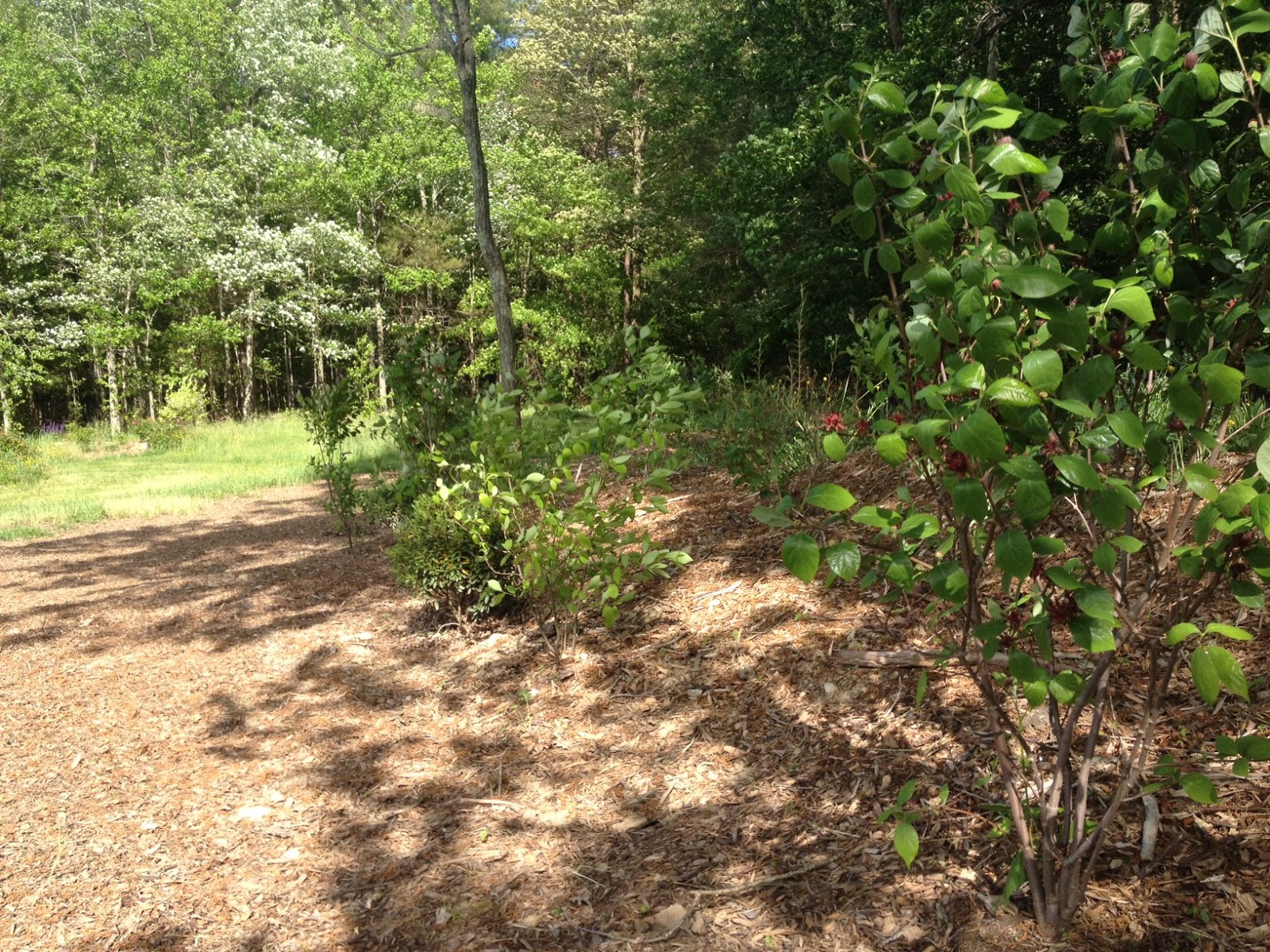
The berms located in the shade of the adjacent forest were planted with native shrubs. Those located in full sun were planted the first season with a soil boosting seed mix, and the next with perennial edible berries and fruit trees. 


For more information visit my website: patriciaceglia.com

Thursday, May 28, 2020

Edible Bayscape at Seven Oaks Elementary School

Last fall I designed an Edible Bayscape for Seven Oaks Elementary School in Perry Hall, MD. Funded by Northrup Grumman, the project was sponsored by the Gunpowder Valley Conservancy (GVC), planned by school staff, and supported by the PTA and Baltimore County Public Schools. 

The site is an enclosed courtyard surrounded by six classrooms and the school library. A symmetrical design clearly distinguished pathways, which protect planting beds from tiny foot traffic. A perimeter border of Blue False Indigo encloses a variety of "outdoor rooms."


      Before
The canopy of a large Oak shelters an outdoor classroom. A magical spiral bed of native ground covers culminates at a sun dial. An ornamental bench is flanked by more native flowers that host beneficial insects. 3 cedar compost bins house decomposing leaves from the Oak tree. A circular herb garden compliments a modern sculpture, a memorial to a child who died. Raised linear beds, one for each grade accommodate vegetables. 


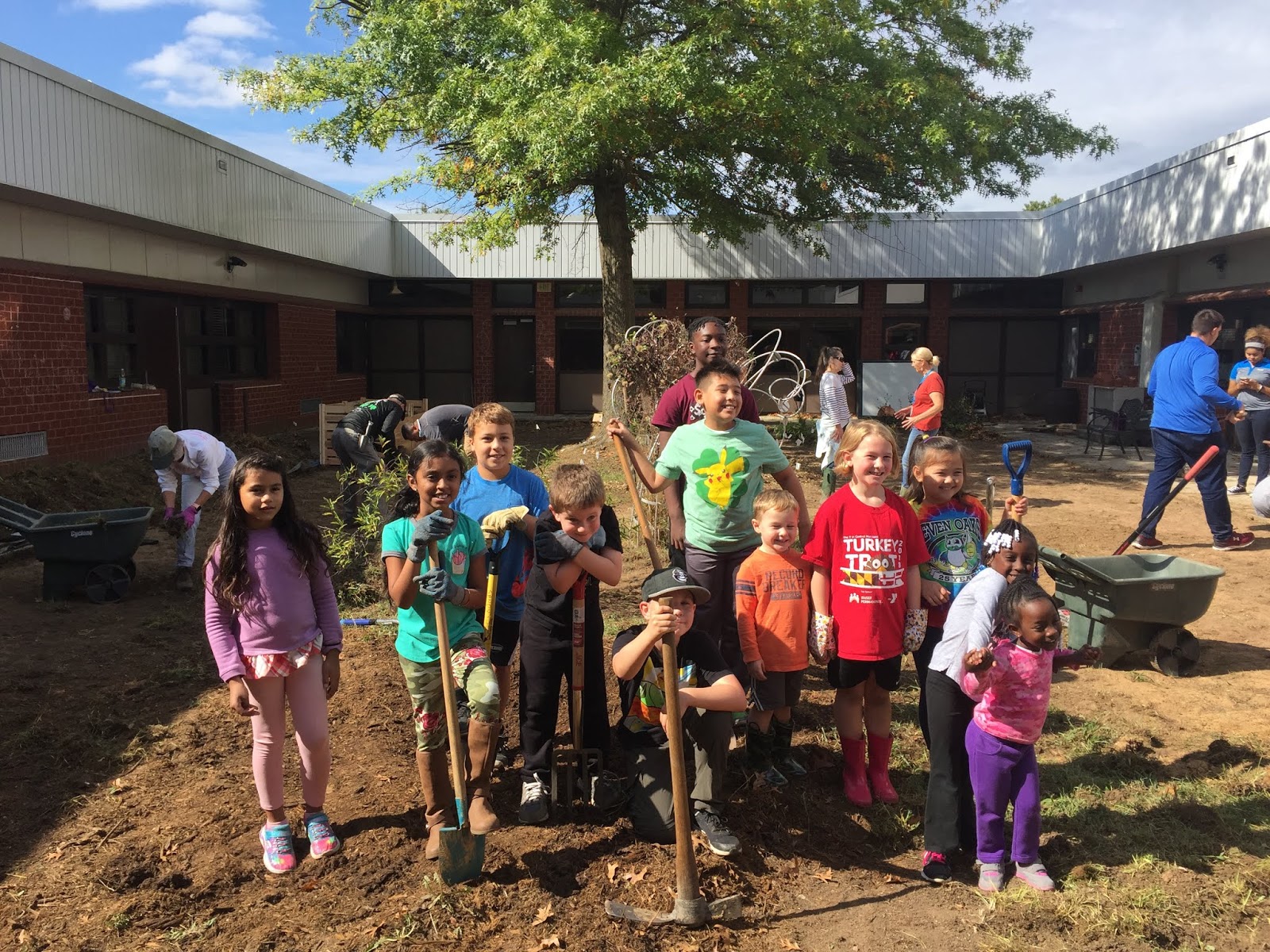
The Bayscape was installed in several work sessions by children, their parents, teachers, a local master gardner, volunteers from the neighboring senior center, and GVC interns. The site was cleared of weeds and grass, the soil loosened, leaf compost applied and the beds mulched. Wood chips define the pathways. F
all is a great time to plant, even though plants are going dormant. Roots become established during the winter, strengthening plants for their emergence in spring. 


After
This Bayscape will be maintained by children in the Seven Oak Elementary School's Garden Club, guided by a volunteer from the University of Maryland's Master Gardner program. 

For more information visit: 
patriciaceglia.com
gunpowdervalleyconservancy.org


Sunday, April 28, 2019

Goucher College Community Garden Permaculture Design

I recently coached Goucher College's Ag Co-op in Permaculture Design. Through a series of 5 workshops, students generated a master plan for the campus community garden. Using a step-by-step process to guide decision-making, we started by clarifying the club's Vision:

  • Demonstrate regenerative agricultural systems 
  • Produce food for the greater college community 
  • Create educational opportunities for all academic disciplines 
  • Exhibit models of social justice and environmental stewardship
  • Be financially self-sustaining
  • Accommodate social space where people can connect with each other
  • Provide a healing environment where people can connect with nature and enjoy beauty
            Site Analysis of the Goucher community garden

Students identified program Needs;
practiced Observation; studied nature's Patterns; conducted Site Analysis to determine design parameters; brain-stormed Opportunities and researched their feasibility; explored Plant Guilds.

WIND:  The garden site is located at the bottom of a slope in a cold sink.  It is also buffeted by north winds, concentrated by a wind tunnel effect from campus buildings located upslope.

Solution: A windbreak of native evergreen shrubs, planted behind the 4' high solid wood fence will protect the garden from damaging winds. Facing south, this windbreak will also function as a suntrap, providing a beneficial microclimate for sun-loving edibles.

SUN:  The design takes advantage of a 3-story, southeast facing stone wall at one side of the garden by locating a half-hoop house to extend the growing season. This wall acts as thermal mass, storing the sun's heat during the day, providing passive solar energy for the unheated greenhouse at night. It also creates a microclimate in front of it, ideal for heat-loving edibles, like figs!

WATER:  Our site analysis during a rain shower revealed that the garden slopes slightly away from the building toward the long length of fence. Swales can be constructed along the slope contours, and above raised garden beds to harvest this run-off for passive irrigation and to prevent soil erosion.

     Permaculture Design for the Goucher community garden
Two large cisterns on site collect water from a rubber roof, which is toxic to edibles.  Students located a new rain barrel at the corner of the existing tool shed, which has a non-toxic green roof. Native shrubs and flowers can be watered from the cisterns; edibles from the rain barrel, as well as from the existing hose.

SOIL: Compost tumblers recycle kitchen waste from students and the campus dining hall.

PATHWAY:  Inspired by the sunburst pattern, the pathway accesses all areas and entrances to this irregular shape using the least amount of space.

LABOR:  Work will be shared by co-op members and volunteers.

PLANTING SCHEME:  The garden perimeter is zoned for
perennials, with taller fruit trees at the north end to allow sunlight to reach shorter plants. Annual crops, which require more attention, are assigned to the garden interior, where rectangular raised beds accommodate row tunnels in cold weather. Guilds of native flowers will support fruit trees and berries.

Since students will not be on campus during the summer season, spring and fall crops will be prioritized, along with long season crops, which mature in the fall (winter squash, apples...).

PRODUCE will be shared with the campus community and the homeless.

CASH CROPS: Bon Appetit, the campus dining hall will purchase fresh culinary herbs from the Ag Co-op.  Garlic will be another great cash crop, since it requires minimal work, has a high value, and can be dried for storage.

A few raised beds can be rented to students or faculty for a modest fee.

SOCIAL SPACE:  A shade arbor, located in the center of the garden, can also host a grape vine.


For more information visit:  green@goucher.edu
                                                patriciaceglia.com

Monday, March 4, 2019

Waterfront Swales with a Hugelkultur and Dune

Run-off area
At this residential property on the Maryland coast, I was tasked with designing a native landscape to manage polluted stormwater coming from the road, running down the driveway, across the lawn, and ultimately exiting into a cove on the Chesapeake Bay. 

Due to underground utility lines and space constraints, the only location for this new device was at the waterfront. 

Beach litter collected for Hugelkultur

Waterfront site, BEFORE


The design consists of two adjacent swales and berms. The level swales are filled with wood chips, which act as a sponge, collecting the stormwater and enabling it to percolate into the soil, interrupting its journey to the bay. The plant roots at the berms absorb this water as passive irrigation. 

Installed in October, the upper berm was constructed as a hugelkultur, mounded with harvested beach litter (drift wood and seaweed) and covered with the soil excavated from the swale above. My client had already imported sand to make an artificial beach, and asked me to construct the lower berm as a dune.

Berms and swales under construction
Mimicking the local coastal plant community, the upper berm was planted with native shrubs that tolerate brackish water, some growing in the wild area right next door. Their woody roots will anchor the soil against the deluge of stormwater during harsh storms, and buffer strong winds off the Bay. These shrubs also create privacy for the beach by blocking the view from the road. The Southern Bayberry fixes nitrogen in the soil. 


Before planting; after the first rain
In a functional landscape, every component serves at least one purpose, besides providing beauty. The dune was planted with local, salt tolerant grasses and flowers, which will attract beneficial insects like bees and butterflies.  To create a gentle transition between this native landscape and the lawn, I added some non-native aromatic herbs and ground covers. These will deter mosquitos, and eventually negate the need for mulch. 

Finished Rain-scape; swales filled with wood chips (winter)
Hugelkultur swales and berms with driftwood and beach litter
Hugelkultur berms and swales were built with driftwood and seaweed, adjacent to the wilderness next door.  Native trees will be planted there next year, after the hugelkultur has decomposed a bit.

Fall is a great time to plant because new plants can go dormant while their roots establish over the winter.  There is no stress from hot summer temperatures or the need for daily watering.  When spring comes the following year, plants stand of better chance of thriving without constant attention. 


For more information visit my website at:  patriciaceglia.com

Monday, January 7, 2019

A Native Edible Riparian Buffer

Volunteers planting live stakes into the river bank.
Last spring I designed a riparian edge for a Gunpowder Valley Conservancy Bayscape Program participant whose lawn borders the Gunpowder River in Kingsville, MD.  Our objective was to restore the eroded river bank by planting trees and woody shrubs to hold the soil in place.  Two existing Pin Oaks, and a Quince (shrub) were preserved.

Live Red Twig Dogwood stakes were planted directly into the stream bank by making 18" holes with a steel rebar.  These will create a brilliant splash of color in the winter time.

Native edible trees and guild plants 
Native trees and woody shrubs were planted at the top of the bank.  These included a beautiful Red Bud (a nitrogen fixer), and edible Paw Paws and Common Persimmon.  Red Elderberry and Sheep Laurel and provide the shrub layer.

An herbaceous guild supports the edible trees with delicate Eastern Columbine (another nitrogen fixer), Wild Bleeding Heart (a beneficial insect host) and Nodding Onion (a dynamic accumulator), plus shade-loving Green and Gold, Cinnamon Fern (with edible fiddleheads) and Christmas Fern. Existing moss was left intact.

To give these native trees and plants a jump-start and increase their root mass, we added a microbial mycorrhizae innoculant to the soil.

A fully effective riparian buffer would need to extend at least 50' in depth from the stream in order to successfully filter sediment.  However, by replacing lawn, this demonstration riparian buffer, once established, will help stabilize the river bank, patch a hole in the wild life corridor, and provide fresh, organic, autumn fruit for the property owners.

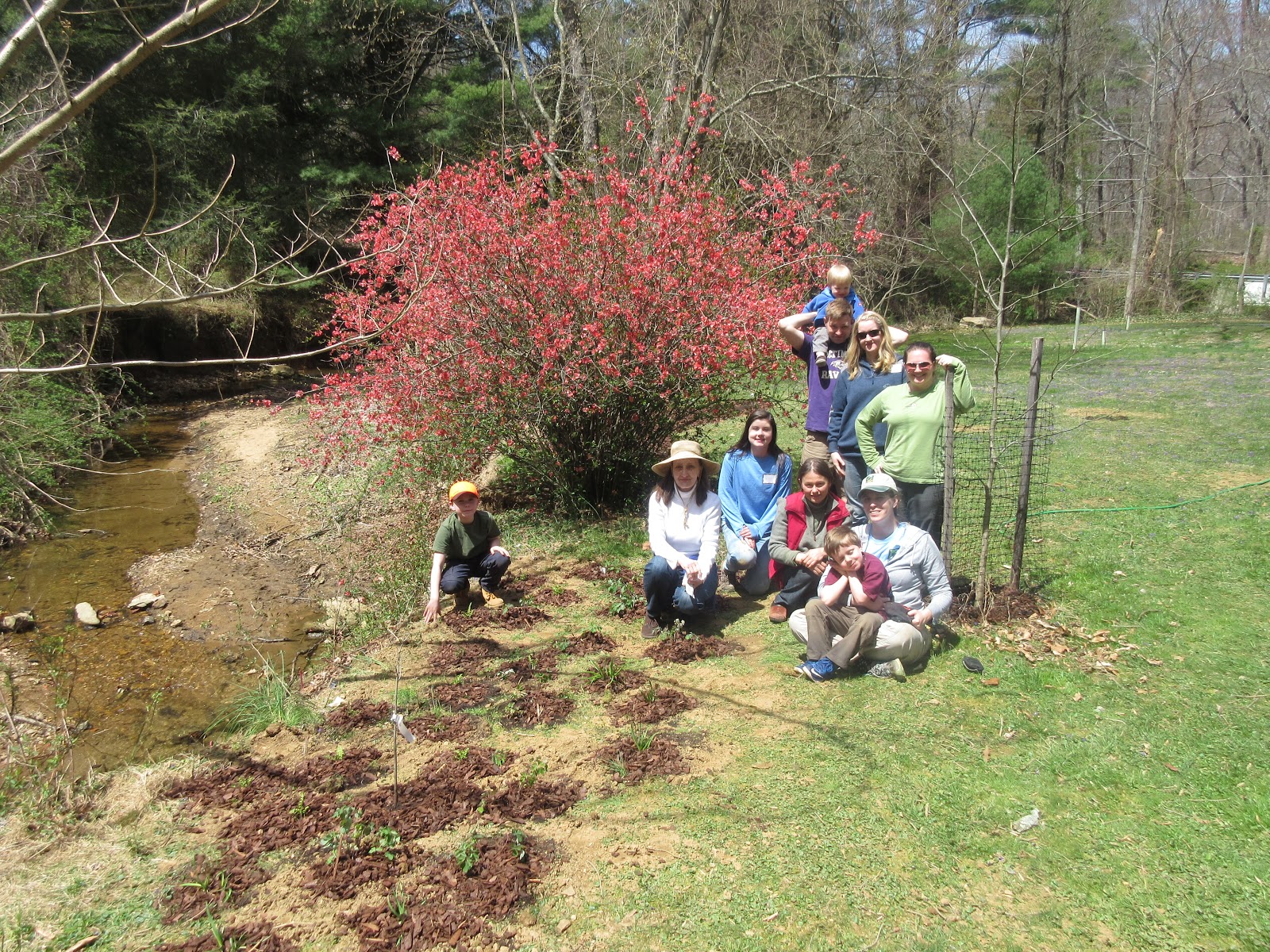
Gunpowder Valley Conservancy volunteers with the finished project.


For more information:  pceglia@gunpowdervc.org 

Friday, December 7, 2018

A Bayscape for Stormwater Management


Before
As a consultant for Gunpowder Valley Conservancy, a nonprofit watershed stewardship, I design and install several Bayscapes each year for local homeowners. These native landscapes are constructed with plants, shrubs and trees that are found in this coastal region of Maryland. They are situated at sites where stormwater run-off is causing erosion or pooling.  I typically include swales and berms as a water capturing device.

The example depicted here shows where stormwater from a driveway runs down a sidewalk and collects at the corner of the house, resulting in a soggy area.

This Bayscape was installed with funds from Gunpowder Valley Conservancy grants and labor assistance from local volunteers. A series of swales and berms were laid out along the contour of the slope, just below this shady corner of the sidewalk, to disperse the stormwater run-off. The berms are created with soil from the swales and planted with water-loving natives. Understory trees and shrubs, located at the north edge, include a Redbud, Elderberry, Red Twig Dogwoods, Spicebush, Arrowmwood Viburnum, and Inkberry. These were underplanted with Eastern Columbine, Woodland Phlox and several types of Fern.
After


Since native plants are adapted to local climatic and soil conditions, they are a practical means of reducing landscape maintenance. Many have duel functions, which minimize the need for soil amendments and insect control. Redbud and Columbine fix nitrogen in the soil; Spicebush and Phlox are beneficial insect hosts; Ferns and Phlox will eventually make a great ground cover, eliminating the need for mulch. The swales, filled with wood chips, double as paths, useful for tending the garden.

This Bayscape is irrigated passively with rain water, reducing the need to get out the hose. A simple strategy of swales and berms not only resolves a stormwater issue, but decreases lawn area, recharges the water table, increases wildlife habitat, and provides natural beauty.


For more information visit my website at:  http://patriciaceglia.com
                                                                     gunpowdervalleyconservancy.org

Thursday, November 29, 2018

Permaculture Design for Stormwater Management


READY trainees at the construction site.
Howard EcoWorks is a nonprofit organization in Howard County, MD. Their "READY" program employs and trains young local residents to build Conservation Landscapes that manage stormwater and reduce flooding from roofs, roads, sidewalks, lawns, and other impervious surfaces.

This past summer, I was asked to design and supervise construction of several Permaculture-style landscapes as part of their "Soak-It-Up" campaign. The techniques we employed harvest and filter stormwater for two suburban sites in Ellicott City, an area of numerous hills and converging streams, that has been in the news recently for severe flooding.

A Rain Garden, Log Terraces, Riparian Buffer, and a Hugelkultur were designated for the first site, a semi-wooded, hillside sloping steeply toward a creek, that floods regularly. The Rain Garden collects water at the bottom of a long gradual slope, and allows it to filter through its basin composed of a sand/compost medium.

Fascines
Located at the top of a slope, a series of stepped Terraces, built perpendicular to run-off flow, intersect the stormwater. READY youth members cut and filled the existing grade to make the steps, and amended the clay soil with compost. Long fallen logs were collected from native trees on site and bundled together to retain the soil in place. (Rot-resistant Black Locust and Cedar are always best, but we used what we could find.) Native water-loving plants - Ferns, Eastern Columbine, Wild bleeding Heart, Elderberry, Inkberry and others - absorb run-off, and are irrigated passively by this low-tech strategy. Although the Terraces have a practical function, the resulting rustic aesthetic suits its wild setting. Once the plants fill in, the effect will be magical.

Swales and Berms
Our second site, a suburban yard, was seriously eroded due to a neighbor's run-off. READY staff constructed two stormwater practices, both located adjacent to the side yard property line to address the issue as far upslope as possible. Swales and Berms, laid out on contours of the slopes with an A-frame level, intercept the water flow. The swales (level trenches) were filled with wood chips, which act as a sponge, holding water and irrigating our sun-loving native plants - Winterberry, Silky Dogwood, Swamp Milkweed, Black-eyed Susan, Blue False Indigo, Eastern Columbine, Blue Flag, Nodding Onion, and Virgin's Bower (a vine).

Fish Scales with an overflow drain
The second, much larger practice was designed as Fish Scales. Again, another series of swales and berms are laid out on contour, but their ends are staggered like masonry, to allow overflow from one swale to exit into the berm below it. Since this location is shaded by canopy trees, the berms were planted with woody shrubs -Witch Hazel, Serviceberry, Sweet Pepper Bush, Inkberry, and Silky Dogwood - to create an understory. The larger the plant the more water it drinks. Our herbaceous layer included Wild Bleeding Heart, Eastern Columbine, and lots of native Ferns. A border of river rock was installed on one side to slow overflow during large rain events.

There are many strategies for managing stormwater issues. The trick to selecting the right technique, or combination of techniques, is to understand the unique characteristics of a site and its water flow.

For more information visit my website at: http://patriciaceglia.com